

Yvonne Halpin
National Delegate (ND) and National Contact Point (NCP) for Horizon Europe Marie Skłodowska-Curie Actions (MSCA)
Irish Universities Association
Marie Skłodowska-Curie Actions: Why we need them and what they can do for you!
Marie Skłodowska-Curie was a highly ambitious, passionate and inspirational scientist, famous for her discoveries of polonium and radium and winner of not one, but two Nobel prizes. In fact, she was the first woman to win a Nobel prize and the first person to win the prize in two different fields! Through her determination in overcoming barriers and her curiosity for the unknown, she demonstrated values which have become some of the central tenets of the European Commission’s Marie Skłodowska-Curie Actions (MSCA).
Through the MSCA programme, the European Union has supported more than 150,000 researchers with many more benefiting from these highly prestigious grants. Behind this investment is the motivation from the EU to build a strong and creative research-based human capital, with the right combination of skills to be able to detect and tackle current challenges of our time, and indeed those future challenges that we don't even know about yet.
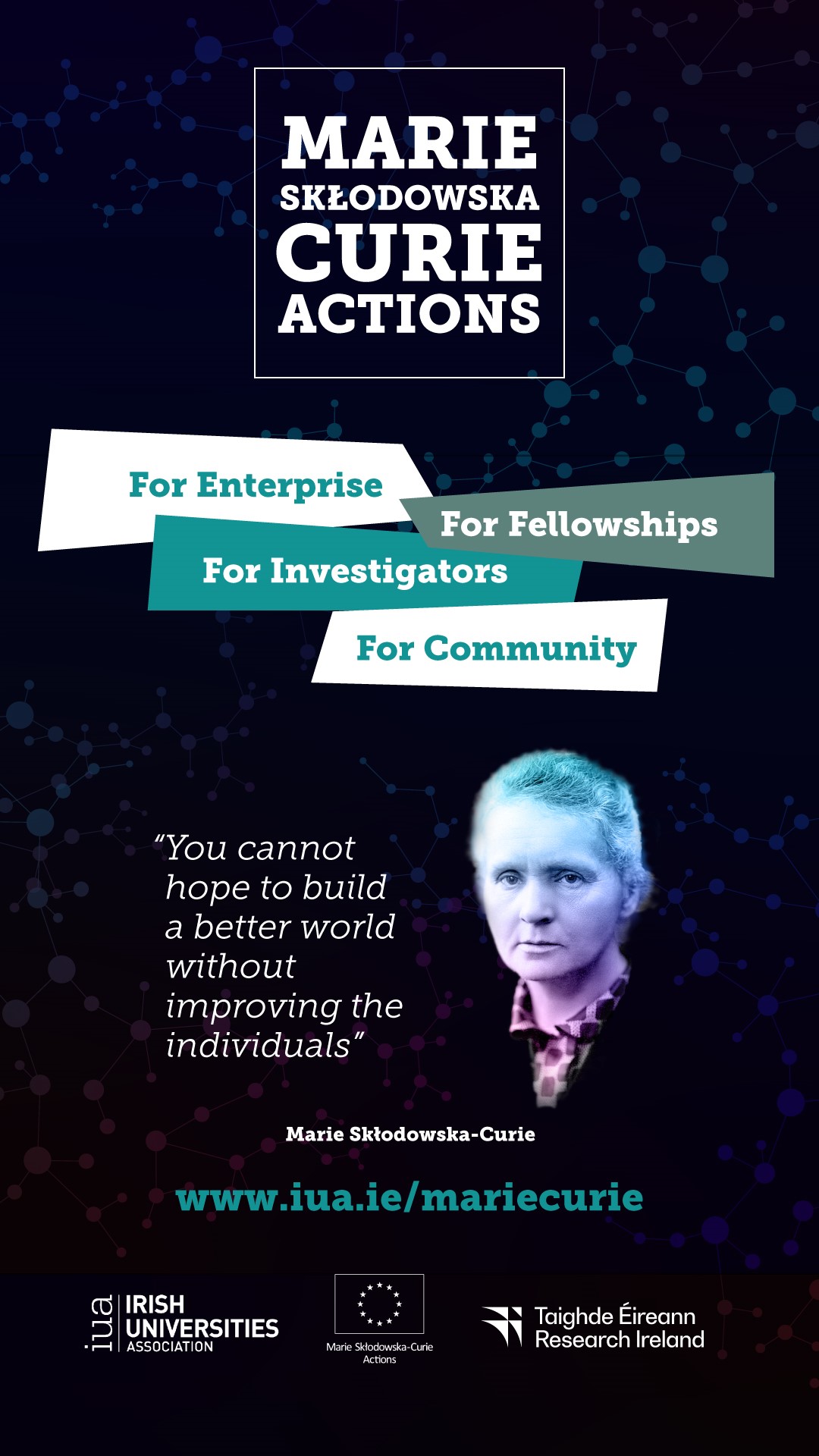
The MSCA ensure that European resilience is underpinned by a talent base emerging from these training programmes which can match the future needs of the labour market, can innovate, and can convert knowledge and ideas into products and services, ultimately for the economic and societal benefit of Europe and its citizens.
With a focus on curiosity-driven excellent research, the MSCA foster talent through innovative research training projects, involving career development and knowledge-exchange opportunities involving the international, intersectoral and interdisciplinary mobility of researchers. MSCA-funded training programmes enhance the skillsets of researchers, equipping them with advanced scientific, technical, and transferable skills so that they can excel across a variety of sectors inside and outside of academia.
The bottom-up nature of the MSCA, a key selling point of the Actions, means that researchers can freely choose their research topic, across all disciplines, presenting a fantastic opportunity for academic researchers to shape their research vision, and indeed for those in the non-academic sector to respond to short, medium and long-term innovation needs. This has been key to supporting a diverse and exciting research culture in Ireland.
Under the MSCA umbrella, there are funding opportunities across four main research and innovation actions, depending on the needs and capacity of the researcher/organisation applying. The Postdoctoral Fellowships scheme funds individual grants of between €200-300k where an organisation applies with a pre-identified researcher to undergo a 2–3-year research project.
The larger consortia-type schemes fund multi-million-euro projects such as the pan-European doctoral training networks where cohorts of PhD researchers collectively address a research problem. Organisations can participate by recruiting researchers directly, by hosting researchers for secondment periods or by being involved in supervision or training activities.
The Staff Exchanges grants fund existing staff within organisations to engage in pan-European research and innovation projects which are implemented via short-term secondments or exchanges to other countries and sectors. Finally, the MSCA COFUND scheme allows organisations to seek co-financing from the EU for the delivery of PhD or postdoctoral training programmes which have leveraged other regional, national or international funding.
Depending on the scheme, and level of participation, 100% funding is provided to cover salaries, research and training costs, travel costs, and the costs of managing participation in the project. Another attractive feature of the MSCA is the reliable nature of the calls. Each of the above actions run every year and the call opening and closing dates for 2025 rounds can be found in the MSCA Work Programme 2023 – 2025.
The Irish Marie Skłodowska-Curie Office is based within the Irish Universities Association and operated under a joint partnership with Taighde Éireann – Research Ireland. The Office offers a range of supports to help Ireland-based organisations across all sectors and disciplines to apply for MSCA funding. Our supports include information sessions, tailored consultancy on large proposals coordinated from Ireland, proposal writing handbooks, workshops, a proposal pre-review service, and query support. Interested applicants can contact us ([email protected]) and check our website for more details on the MSCA funding opportunities. You can also follow us on our X and LinkedIn social media channels for key updates.