

Patrick Lansley
National Contact Point (NCP) for Horizon Europe Cluster 2 - Creativity and Inclusive Society
Irish Universities Association
Culture, Creativity and Inclusive Society – 2024
2024 has been the most successful year for Ireland under Cluster 2 (Culture Creativity and Inclusive Society) so far, with 24 Irish participations from a total of 18 different projects being awarded a total of €7,342,632, taking Ireland’s drawdown under the Cluster to just under €25 million. The deadline in February saw a total of 708 proposals submitted to 28 thematic calls, with results announced over the summer. Since then the awarded consortia have been working their way through the GAP (Grant Agreement Preparation) process, making sure that everything is acceptable to the European Commission before contracts are signed.
Projects with Irish partners include varied subjects such as European food traditions, diverse forms of democratic participation and the role of social economy organisations in tackling social exclusion.
Most excitingly four awards have been made to projects coordinated by Irish Partners:
EMMELO: European Men, Masculinity, and Extremist Leadership Online
Recent years have seen an alarming expansion in extremist activities, particularly through online media. Masculinity and other strongly gendered performances play a key role in the apparent appeal of these communities. The €2.6m EMMELO project, coordinated by the University of Galway leading a consortium of eight organisations across Europe, will examine the role of masculinity in extremist movements online across Europe and the threats it poses to democracy, fundamental rights and EU values, and will develop innovative ways in which to identify, discuss and challenge the issues.
EMMELO is led by Dr Ekaterina Yahyaoui – Senior Lecturer in Human Rights at the Irish Centre for Human Rights, School of Law at the University of Galway.

FORSEE: Forging Successful AI Applications for European Economy and Society.
With the ever increasing rollout of Artificial Intelligence across numerous sectors and contexts, how do we evaluate what constitutes a ‘success’? With a budget of €3m, the FORSEE project led by University College Dublin, along with contributions from Trinity College Dublin and the Think-Tank for Action on Social Change, as well as partners from five other European countries, will engage with a diverse range of stakeholders in order to develop a nuanced and enriched notion of success that will guide future AI applications and policy efforts.
FORSEE is led by Dr Elizabeth Farries, Director of the UCD Centre for Digital Policy.
TechConnect: Assessing and Strengthening Human-Tech Skill Complementarity in the Digital Landscape.
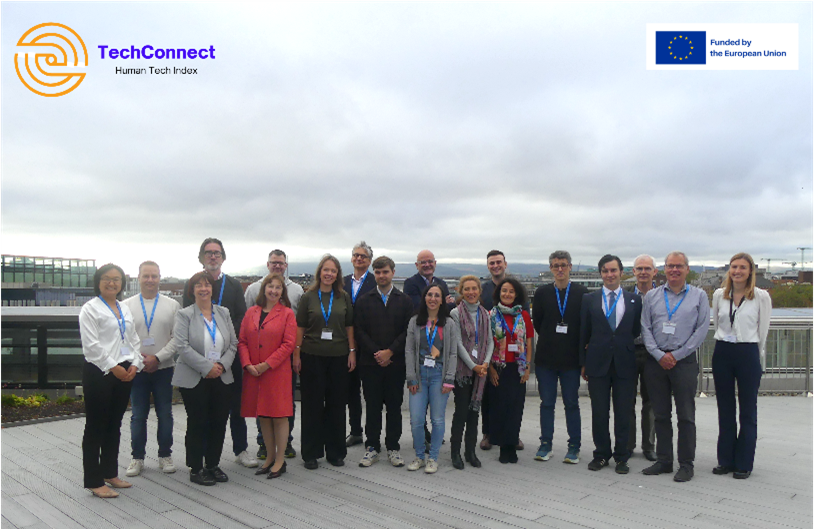
The changing digital landscape has a great impact on the world of work, with new technologies being introduced to a wide range of workplaces, at varying degrees of success. Led by Trinity College Dublin, and in partnership with a range of researchers and hospitals from Spain, Netherlands and Sweden, as well as Tallaght University Hospital in Ireland, the €3m TechConnect project will investigate dynamic interplays between new digital technologies and human skills within healthcare settings in order to develop theoretical and practical knowledge that will enable organisations and policymakers to encourage inclusive growth in the digital landscape, and make a meaningful impact on the quality of employment and competitiveness, contributing to social and economic resilience.
TechConnect is led by Professor Na Fu, Professor in Human Resource Management at Trinity College Dublin.
GenAI4ED: A platform for Assessing and Bridging Generative AI and Human Skills in Secondary Education
With the rapid rise of Generative AI (GenAI) and large language models (LLMs), a wave of new educational tools is transforming the field—and the numbers are set to soar. Irish companies Trilateral Research and Konnektable Technologies are leading a consortium of 11 partners from 6 countries on the €3.3m GenAI4ED project to promote the ethical use of GenAI in education.
The initiative empowers students, educators, and parents to critically assess AI tools, raising awareness of both benefits and challenges. The project will investigate how GenAI is perceived in education and will develop a digital platform to evaluate AI-based educational tools, providing recommendations tailored to the needs of teachers and students alike. The three year project began on 1 October.
All projects funded under this Cluster have potential for significant societal impact, both in Ireland and right across Europe, and even globally. Awardees will have the opportunity to work across international consortia in addressing high priority challenges, and will be able to feed into European policy creation as well as having the opportunity to undertake cutting edge, interdisciplinary research and produce high quality research outputs.
Final calls under Work Programme 2024 have a deadline in January 2025, and focus on the further development of the European Collaborative Cloud for Cultural Heritage. The (single year) Work Programme for 2025 has almost been finalised, and we hope that will be formally published in spring next year.
Our congratulations to all awardees, and we look forward to seeing the projects develop.
Some figures may change following completion of Grant Agreement Preparation.