

Michael Murphy
National Delegate and National Contact Point (NCP) for Horizon Europe Cluster 3 - Civil Security for Society
Enterprise Ireland
Europe’s Budget Pivot: Security, Competitiveness, and Ireland’s Strategic Choices
The European Commission’s proposal for the Multiannual Financial Framework (MFF) 2028-2034 signals a profound shift in EU spending priorities. This shift is in reaction to the full-scale invasion of Ukraine by Russia; the hybrid pressure campaign attributed to Russia such as drone incursions, GPS jamming, cable cuts, arson/sabotage at logistics hubs, and cyber operations; and doubts about US commitment to NATO. It reflects substantial defence funding increases across NATO countries.
The European Parliamentary Research Service (EPRS) overview shows the four main budget headings (illustrated below). Security features explicitly in Heading 1 "Economic, social and territorial cohesion, agriculture, rural and maritime prosperity & security" and in Heading 2 "Competitiveness, prosperity and security". It is implicit in Heading 3 "Global Europe", and a proportion of Heading 4 "Administration" will administer security-related activity.
Beyond the €1.763t total proposed EU budget, the off-balance sheet European Peace Facility is allocated €27.1b and the Ukraine Facility is allocated €100b. Within the current €17.1b European Peace Facility, Irish suppliers probably received little or no business despite Ireland’s pro-rata ~357m€ contribution.
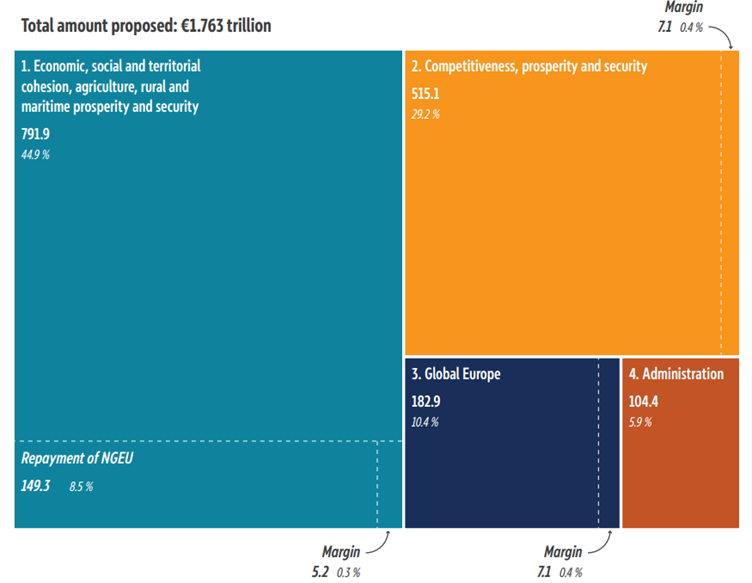
The four main budget headlines proposed by the EC for MFF 2028-2034
Heading 2 "Competitiveness, Prosperity and Security" is the epicentre of the budget pivot. In the diagram below, it’s broken down into its sub-headings.
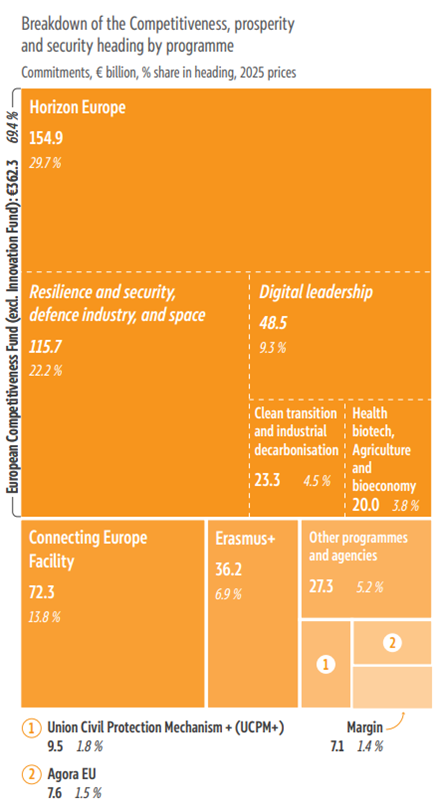
The sub-headings of "Competitiveness, prosperity and security"
The proposed European Competitiveness Fund (ECF) allocates €115.7 billion to the sub-heading "Resilience and security, defence industry and space". The sub-headings: ‘Digital leadership’, ‘Clean transition and industrial decarbonisation’, and even ‘Health, biotech, agriculture and bioeconomy’, will attract significant defence interest. Military mobility funding under the Connecting Europe Facility will surge tenfold to €17.65b, embedding defence needs into transport and infrastructure planning. There is €9.5b for the Union Civil Protection Mechanism.
Despite opposition, the Commission’s approach to the new Horizon Europe programme relies on dual-use logic, civilian programmes that can serve military ends. Horizon Europe’s successor (FP10) will be “open to dual use by default,” with DARPA-style innovation models under the European Innovation Council.
The upshot is that defence and security priorities are reshaping EU industrial, research, and infrastructure policy. For Ireland, this represents both a challenge and an opportunity. To avoid being a passive contributor, Ireland must urgently establish a coherent national strategy that includes: a functioning security clearance regime for personnel and facilities, robust Communication and Information Systems (CIS) accreditation processes, mechanisms for co-funding participation, and a coordinated approach to EU programmes. Without these foundations, Ireland risks significant financial outflows with minimal return. With them, Ireland can position itself to capture value in emerging dual-use technologies.