

Maria Nash
European Research Council National Delegate (ND) and ERC National Contact Point (NCP) for both the Physical Sciences & Engineering and Life Sciences domains, and NCP Research Infrastructures
Research Ireland
European Research Council
Highlights, Transformative Changes and Future Directions
With the 2026 European Research Council (ERC) work programme due for European Commission adoption and publication in July, the spring and early summer has been punctuated with updates and new revelations on current and future ERC calls. Following late-stage amendments to the current 2025 work programme, significant impending novelties can be expected in the 2026 work programme which will be followed by other major changes in 2027.
With these hopefully exciting and positive changes, the ERC continues to evolve in dynamic and ambitious ways, but the introduction of some of these changes may require new ways of honing applications to match new evaluation expectations and adapting to new eligibility criteria.
The following summarises the major operational related developments and other ERC-related highlights of the last few months.
Spring 2025 Highlights: A Momentous Visit and New Voices
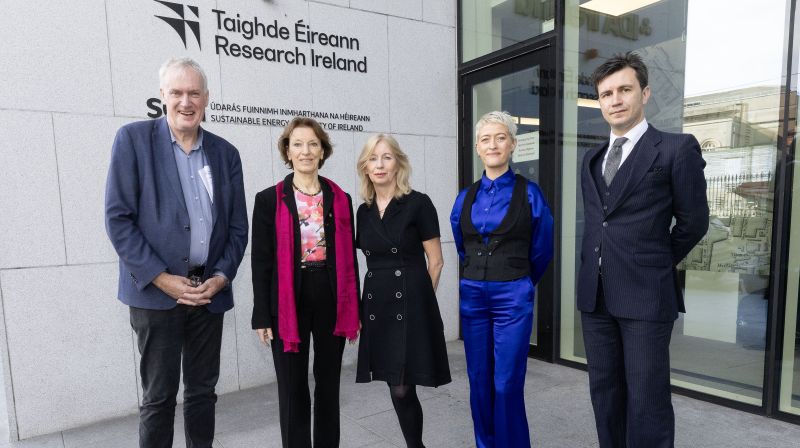
From L-R Prof Luke O'Neill (TCD, ERC Scientific Council), Prof Maria Leptin (ERC President), Dr Maria Nash (Research Ireland, ERC ND & NCP) and Patrick Lansley (IUA, ERC NCP) Photo credit: Finbarr O'Rourke
A particular highlight this spring was the visit of Prof Maria Leptin, President of the European Research Council (ERC) to Ireland in April. To mark the occasion, Research Ireland hosted Prof Leptin, Prof Luke O'Neill (ERC Scientific Council member and ERC awardee) and many of our ERC awardees from across the nation at the National ERC Impact Forum.
The forum was a dynamic celebration of Irish research excellence, showcasing the rich diversity of talent supported by ERC funding across a wide range of disciplines. Throughout the day, a strong message emerged: for Ireland to thrive in an increasingly competitive global research landscape, sustained and enhanced investment in research at both national and European levels is essential. In addition to a full programme of talks and discussions, the event provided an invaluable platform for connection and collaboration among researchers, funders and policymakers.
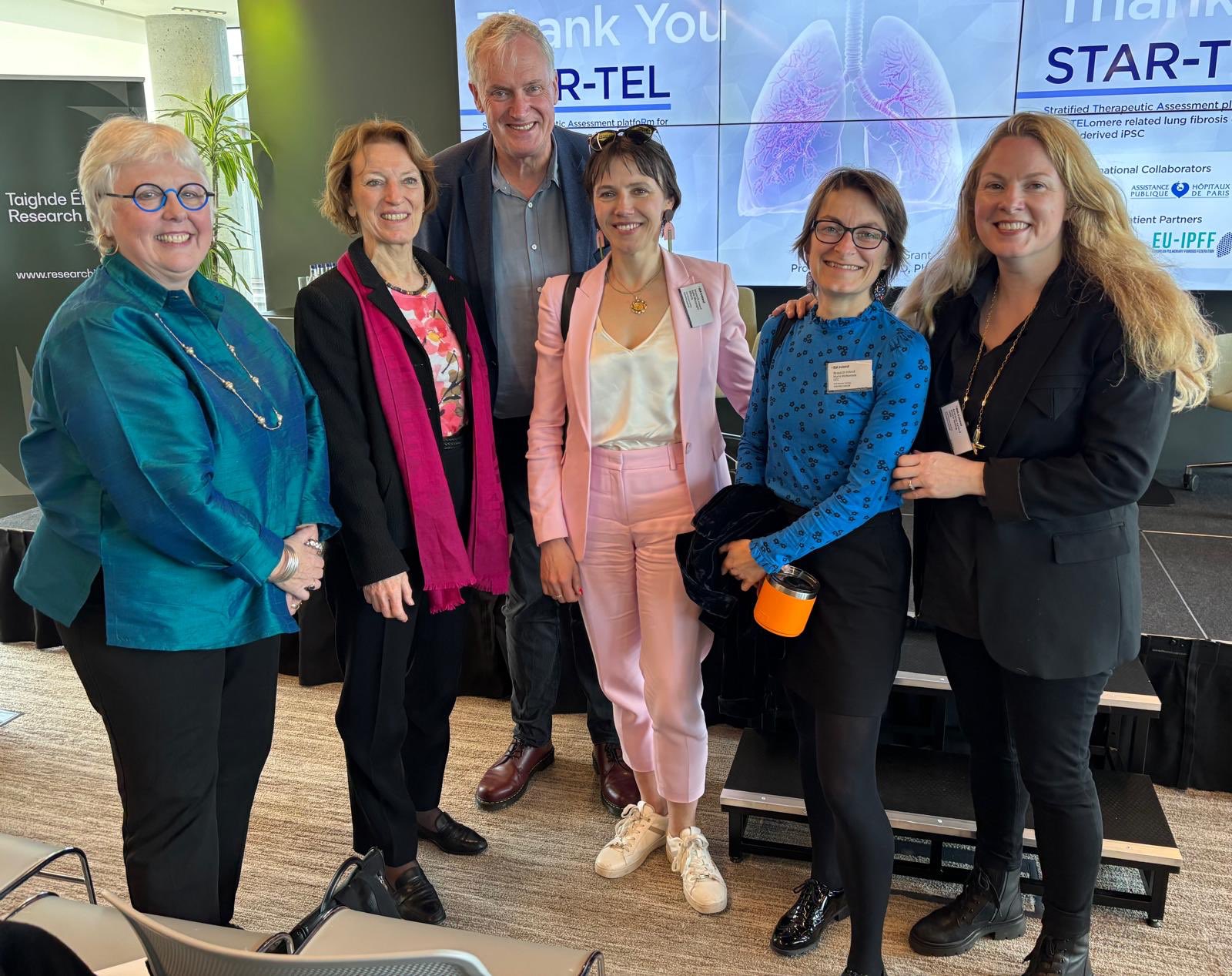
Pictured, L-R: Prof Jane Ohlmeyer (TCD), Prof Maria Leptin (ERC President), Prof Luke O'Neill (TCD, ERC Scientific Council), Prof Aoife McLysaght, (TCD, Government Science Advisor), Prof Maria McNamara (UCC), Prof Emma Teeling (UCD) Photo credit: Finbarr O'Rourke
Following the forum, Prof Leptin met with An Taoiseach Micheál Martin to further discuss the critical importance of frontier research, the strength of Irish research and the future of European framework programming. The day concluded with a dinner at the Provost’s House in Trinity College Dublin, attended by Minister James Lawless, university leaders and colleagues from across the island. The evening served as a fitting conclusion to a day filled with impactful dialogue and a collective reaffirmation of the value of investing in research.
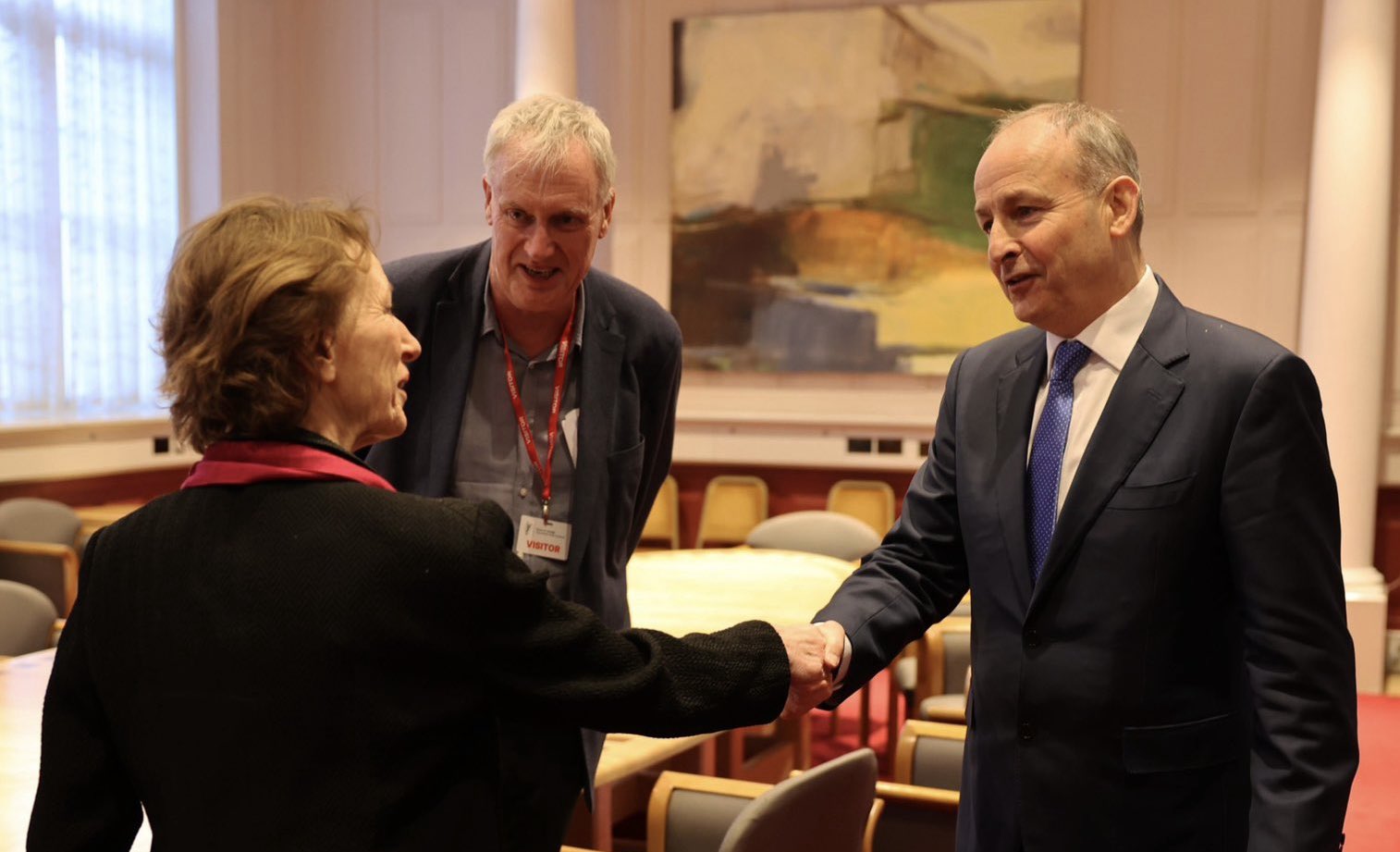
Pictured, L-R: Prof Maria Leptin (ERC President), Prof Luke O'Neill (TCD, ERC Sceintific Council) and An Taoiseach Micheál Martin. Photo credit: Keith Arkins
In other exciting April ERC news, the ERC with the Association of ERC Grantees (AERG) launched the new Ambassadors for the ERC network. Among the 32 ERC-awardees appointed was our own Prof Susi Geiger (UCD), Ireland’s first ERC Ambassador. Ambassadors will serve as key communicators and champions for the ERC and advocates for frontier research and researcher independence across Europe. We warmly welcome Susi into this role and look forward to working closely with her in expanding awareness of ERC funding across Ireland and beyond.
2025 Work Programme Amendment and ERC 2026 Work Programme - Evolving Opportunities and a Forward Looking Programme
An amendment to the ERC 2025 Work Programme was announced in early May and was adopted before the Advanced Call opened in late May, which formalised the ERC’s decision to increase its support for leading researchers moving to Europe and applying for an ERC grant. Additional funding of up to €2 million is now available for applicants relocating to the EU or an associated country. This funding can be used for any of the existing eligible cost categories (e.g. start-up costs, major equipment, large facilities, or fieldwork) and personnel costs are no longer excluded from the above eligible cost categories.
It is the ERC’s intention to maintain this additional amount for all grant competitions in 2026 and 2027.
Furthermore, planning is underway for the pilot of a new category of funding, being widely referred to as ERC Super Grants. While still under development, these seven-year grants are intended to support transformative, high-risk/high-gain research projects of exceptional scale and ambition. They will be aimed at researchers with an outstanding track record who are ready to take major leaps in their fields. Details, including eligibility criteria and timelines, are expected to be finalised in the second half of 2025, with a likely pilot call launched after an amendment to the 2026 Work Programme late this year.
Looking ahead to the more known elements and mooted novelties expected in the 2026 ERC Work Programme, several key changes to how applications are structured and evaluated have been flagged:
Proposals will still comprise two parts, but the content and emphasis should focus as follows:
Part I - (formerly the Extended Synopsis) will focus on the overarching idea, scientific questions and research strategy - limited to five pages.
Part II - will detail methodology, work plan, risk assessment and budget justification - limited to seven pages for Starting, Consolidator and Advanced Grants, and ten pages for Synergy Grants.
Evaluation will also be split into two steps. Step 1 will assess Part I, the CV and the track record, focusing on the ambition and novelty of the idea. Only proposals that pass this stage will proceed to Step 2, where feasibility, methodology and resource allocation will be evaluated. Notably, feasibility will no longer be assessed at Step 1, allowing applicants to focus on the conceptual strength of their proposal early on.
The ERC 2026 calls are expected to follow the traditional timelines of recent years:
Starting Grants: Call opens July 2025, deadline likely October 2025
Consolidator Grants: Call opens September 2025, deadline likely January 2026
Advanced Grants: Call opens May 2026, deadline likely August 2026
Synergy Grants: Call opens July 2025, deadline likely November 2025
As always, we encourage researchers to begin preparations well in advance to ensure strong, competitive submissions, particularly given the competitive nature of ERC applications and the depth of detail required.
ERC 2026 - Other Novelties
Briefly, in terms of eligibility extensions and additional submission restrictions:
- Parental leave – now included alongside maternity and paternity leave to acknowledge the diversity of applicants’ personal circumstances.
- Gender-based or any other form of violence – applicants who have been victims of violence are now eligible for an extension on these grounds.
- Applicants to Synergy Grant 2025 call, who have obtained a score ‘B’ at Step 1 will not be eligible for the Synergy Grant 2026 call.
- Current grantees applying for their next grant in 2026 must abide by the two-year rule (i.e. their current grant must end within two years of the call deadline) but extensions to the duration of the current project after the call deadline may be exceptionally granted without affecting the eligibility of the new proposal.
Finally, a major increase is expected in the pot allocated to the Proof-of-Concept Calls in 2026.
ERC 2027: Looking Even Further – Major Changes
Although still at an early planning stage, some information on the 2027 ERC Work Programme has already been revealed, with the ERC introducing a pivotal change by broadening the eligibility periods for both Starting and Consolidator Grants.
From 2027, researchers can apply for a Starting Grant, immediately after defending their PhD and up to ten years afterwards and Consolidator Grant eligibility shifts to between five- and fifteen-years post-PhD, while all current extension policies remain in force (e.g., parental leave, documented career breaks).
Note: A researcher can receive no more than one Starting Grant and one Consolidator Grant throughout their career.
National Supports for ERC Applicants: Plan Early, Apply Boldly
With such rich funding opportunities on the horizon, we strongly encourage researchers in Ireland, whether early-career or established, to consider applying to the ERC. Frontier research is the engine of discovery, and the ERC remains the premier funder of investigator-led, high-risk/high-reward research in Europe.
To help applicants succeed, Enterprise Ireland offers an ERC Proposal Preparation Support Grant, which provides up to €16,000 to institutions to support high-quality ERC applications. This grant can be used to fund expert review, writing support, and other services. A key condition is that applications must be submitted at least six months prior to the relevant ERC call deadline, so early engagement is vital. Please contact your Research Office if looking to apply.
For guidance at any stage of the process, applicants are welcome to contact me (Research Ireland, National Delegate and STEM domains National Contact Point; [email protected]) or my colleague Patrick Lansley (IUA, ERC National Contact Point for SSH; [email protected]).
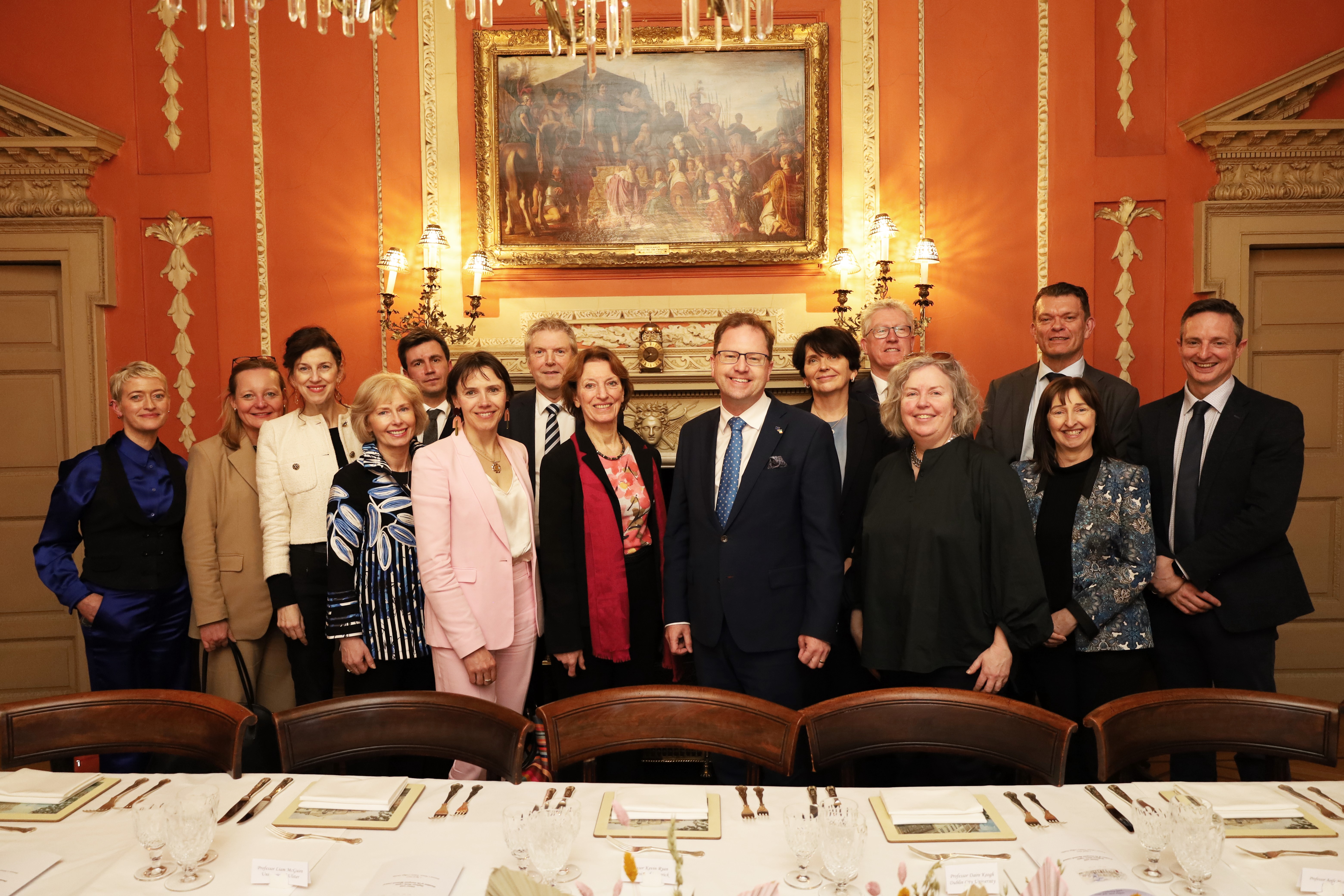
Dinner Reception at the TCD Provost House for ERC President. From L-R: Dr Maria Nash (Research Ireland, ERC NCP), Sabine Simross (ERC, Assistant to the President), Madeleine Drielsma (ERC, Press Adviser to the President), Doris Alexander (TCD, Associate Director for European Engagement), Patrick Lansley (IUA, ERC NCP), Aoife McLysaght, (TCD, Government Science Advisor), Prof Liam Maguire, (Ulster University Pro Vice-Chancellor Research), Prof Maria Leptin (ERC President), Minister James Lawless (Minister for Further and Higher Education, Research, Innovation and Science), Prof Orla Feely (UCD President), Prof Dáire Keogh (DCU President), Dr Linda Doyle (TCD Provst and President), Prof Richard Miles (QUB Provost and Deputy Vice-Chancellor), Prof Sinéad Ryan (TCD Dean of Research), Prof Kevin Ryan (UL Vice President for Research) Photo credit: Sianna Fallon