

EuroHPC's New Mandate: What Changes for French and Irish Actors and Why It Matters for Bilateral Collaboration
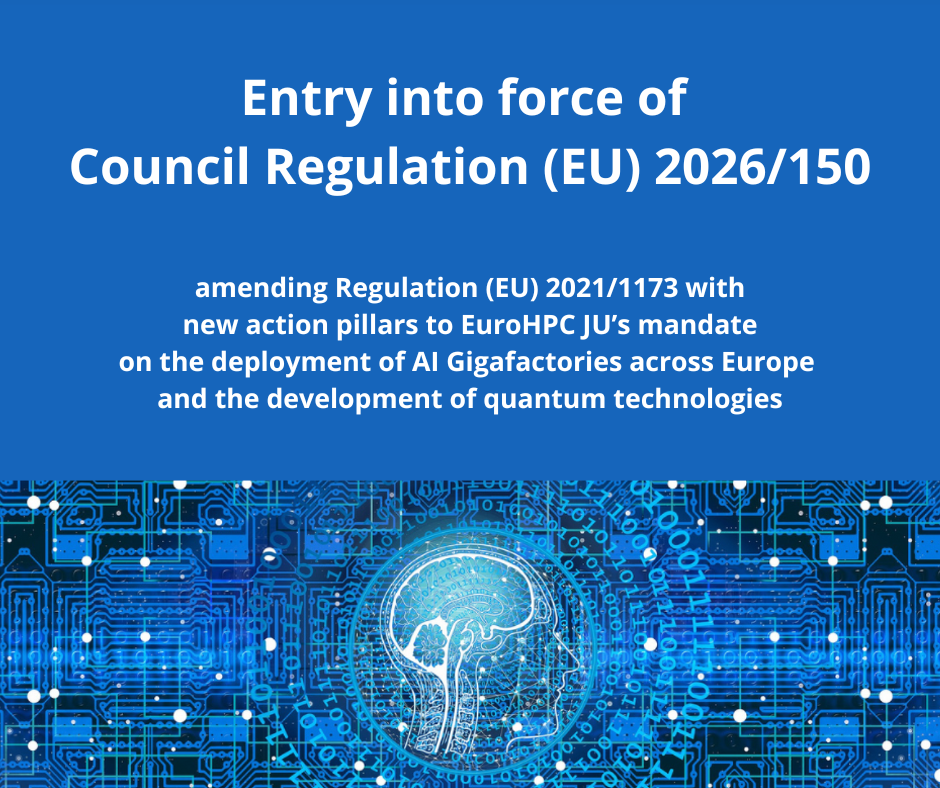
EuroHPC is no longer just a supercomputing programme. A regulatory amendment adopted by the Council of the European Union on 16 January 2026 (Council Regulation (EU) 2026/150) has formally expanded its mandate in two directions that directly concern French and Irish actors: the deployment of AI Gigafactories and the integration of a dedicated quantum technologies pillar. Understanding what these changes mean in practice is the starting point for identifying where Franco-Irish collaboration opportunities lie.
What Changed and Why It Matters
Until recently, EuroHPC's role was defined primarily around procuring and operating supercomputers and, since 2024, supporting AI Factories. The new regulation does three things.
First, it elevates AI Factories into AI Gigafactories: ultra-scale, energy-efficient facilities designed to support the full lifecycle of very large AI models, from training to inference, open to European researchers, startups, and industry. Up to five Gigafactories are planned across Europe, with calls expected in the first half of 2026.
Second, it integrates the Quantum Flagship, previously managed through Horizon Europe, into EuroHPC's work programme. This means future quantum research and innovation calls, and quantum system procurement, will increasingly run through EuroHPC. A new Quantum Technologies Advisory Group (QTAG) is being established within EuroHPC's governance structure to guide this agenda.
Third, it brings frontier AI training, large-scale inference, and hybrid quantum-HPC infrastructure under a single governance and funding framework for the first time. For actors in both countries, this consolidation matters: it simplifies the institutional landscape and creates clearer pathways from research to infrastructure access to funding.
What It Changes for French Actors
France enters this new phase from a position of genuine industrial and institutional strength. The country has invested over €1.8 billion in its national quantum strategy, and French quantum startups (Quandela, Pasqal, Alice & Bob, Quobly, C12) collectively represent one of the most diverse photonic and superconducting quantum ecosystems in Europe.
The most visible recent illustration is Lucy, inaugurated on 14 April 2026 at the Très Grand Centre de Calcul (TGCC) of the CEA near Paris. Built by Quandela with cryogenic systems from its German partner Attocube, Lucy is the world's most powerful photonic quantum computer. Procured by EuroHPC through GENCI under the EuroQCS-France consortium and co-funded by France 2030, it is now freely accessible to European researchers and industry, coupled to the Joliot-Curie supercomputer within the Hybrid HPC Quantum Initiative (HQI) platform. Its inauguration on Quantum Day 2026 was not an isolated event: it was a signal that France's integrated model, from fundamental research to sovereign industrial deployment within a European framework, is producing results.
On the AI side, France operates AI2F, one of Europe's most advanced AI Factories, built on GENCI's exascale infrastructure including Alice Recoque. AI2F has been positioned within France's broader quantum strategy as an infrastructure designed to evolve alongside quantum computing developments, with an orientation toward future hybrid HPC-quantum integration. For French institutions and companies, the new EuroHPC mandate creates a more direct and consolidated funding pathway for the next generation of infrastructure they are already building.
What It Changes for Irish Actors
Ireland's position has shifted considerably over the past six months. Two developments, both formalised in October 2025, define the new landscape.
The first is CASPIr. The signing of the hosting agreement between EuroHPC JU and the University of Galway, home to the Irish Centre for High-End Computing (ICHEC), paves the way for Ireland's new national supercomputer. With a capacity exceeding 15 petaflops, CASPIr will support AI and machine learning workloads, digital twins, climate modelling, and life sciences applications. The procurement process is now underway, with a deadline for participation requests on 5 May 2026. CASPIr will position Ireland within the European EuroHPC network, which currently spans 35 participating countries and 12 procured supercomputers, and is expected to come into service in 2027.
The second is the AI Factory Antenna. Ireland's AIF IRL-Antenna was awarded €10 million in European and national co-funding, led by ICHEC and CeADAR, with a consortium of enterprise accelerators and digital skills networks across the country. Critically, the Antenna is specifically linked to AI2F, France's national AI Factory, covering infrastructure and data sharing, joint talent development, federated data spaces, and policy co-development. This is not a general European partnership: it is an explicit, funded, operational link between the Irish and French AI ecosystems.
On the quantum side, Ireland's position is stronger than it might appear from the outside. Equal1, the Dublin-based semiconductor quantum computing company, has developed the Bell-1 system: a rack-mounted, room-temperature silicon CMOS quantum computer whose design philosophy targets industrial deployment rather than laboratory environments. It is a different approach from the cryogenic systems dominant in French and European programmes, and a complementary one. With the EuroHPC quantum mandate now covering not just computing but also quantum simulation, communication, and sensing, Irish actors with hardware and integration expertise have concrete pathways into a European ecosystem that is actively seeking technological diversity.
For Irish companies and research groups more broadly, the new EuroHPC quantum mandate opens access to infrastructure that did not exist two years ago. Lucy, operational at CEA's TGCC, is already freely accessible to European users. The next quantum systems being procured for the Netherlands, Luxembourg, and beyond will further expand the portfolio. Irish actors do not need to build quantum hardware to benefit; they need to identify the application domains where hybrid HPC-quantum workflows generate value, and position themselves accordingly.
The Franco-Irish Bilateral Opportunity
The structural link between Ireland's AIF IRL-Antenna and France's AI2F creates something new: a live institutional channel between the two countries' computing ecosystems, embedded within the European infrastructure framework. This channel did not exist two years ago. It is now funded and operational.
Several practical collaboration opportunities follow directly from this.
On AI, joint use of EuroHPC infrastructure is the immediate entry point, with Irish researchers and companies accessing Alice Recoque via AIF IRL-Antenna, and French users accessing CASPIr once deployed. Application sectors where both ecosystems have depth include pharmaceuticals and life sciences, financial services, agri-food technology, and climate and energy modelling. Shared access to computing infrastructure is the starting point; joint R&D projects through Horizon Europe consortia are the natural next step.
On quantum, the Equal1-Bull MoU signed in Dublin on 14 April 2026, the same day as Lucy's inauguration, is the clearest bilateral signal. Equal1's Bell-1 silicon CMOS quantum computer, designed for industrial deployment at room temperature, and Bull's sovereign computing capacity represent complementary assets. The MoU covers four axes: R&D characterisation, technical integration, European project collaboration, and technical exchange. Together they provide a working template for what Franco-Irish quantum cooperation can look like in practice.
For organisations not yet engaged with either ecosystem, PHC Ulysses, the Franco-Irish bilateral scientific cooperation instrument, remains an efficient mechanism for initiating research partnerships that can subsequently scale into European project consortia. It is the lowest-friction entry point into a collaboration landscape that is becoming progressively more institutionalised and funded.
Open Calls
EuroHPC operates several access modes simultaneously, each targeting a different type of user and project scale.
Infrastructure access:
Development Access and Benchmark Access — both continuously open with monthly cut-offs (next: 1 May). Designed for researchers and developers testing or optimising code on EuroHPC systems before committing to larger bids. Resources available within 2–3 weeks of submission.
Extreme Scale Access — provides access to LUMI, Leonardo, MareNostrum 5, and JUPITER. Cut-off in 2026: 19 October. Open to all fields of science and industry.
Regular Access — open to academia, industry, and the public sector through Scientific, Industry, and Public Administration tracks. Next cut-off: 4 September 2026. Resources accessible within four months.
Procurement and funding:
CASPIr tender — the University of Galway and EuroHPC JU have launched a tender for Ireland's future national supercomputer. Deadline to submit a participation request: 5 May 2026. Directly relevant to HPC hardware vendors and systems integrators.
AI Gigafactory call — expected imminently, backed by the €20 billion InvestAI facility. Targets consortia capable of operating large-scale AI compute infrastructure at national or multi-country level. Up to five Gigafactories will be selected across Europe.
What to Watch
Over the coming months, several developments will shape how these opportunities translate into concrete calls and projects. EuroHPC's Quantum Technologies Advisory Group will begin its work and is expected to feed into the next Multi Annual Strategic Plan, influencing the shape of future quantum procurement and research calls. The AI Gigafactory selection process will open, with implications for infrastructure partners and technology suppliers in both countries. CASPIr's procurement process will conclude, and with it, the beginning of Ireland's full integration into the EuroHPC supercomputing network.
France and Ireland share a bilateral framework, the Joint Strategic Framework 2026-2030 accompanied by an operational Action Plan, that explicitly identifies computing infrastructure, quantum technologies, and AI governance as areas for cooperation. The EuroHPC mandate expansion does not create this alignment: it operationalises it.