

The European Innovation Council: novelties on Late-stage large-scale financing
Closing the late-stage financing gap is essential for the European Union to maintain its competitive edge in fast-moving disruptive technology sectors. Despite Europe retaining a strong global standing in driving innovation and creativity in several strategic industries, strong support is needed to ensure EU companies have access to large-scale financing (figure 1).
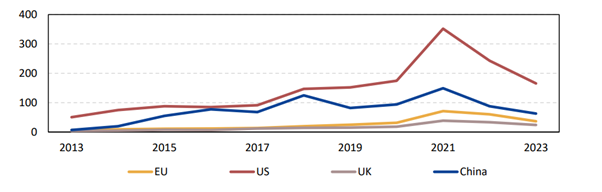
Figure 1: Venture capital investment ($bn).
Source: The scale-up gap Financial market constraints holding back innovative firms in the European Union, EIB2024, ISBN 978-92-861-5788-2 doi:10.2867/382579.
Scale-ups are young, medium-sized firms with high growth potential, more productive than the average company, and a leader in the development of new technologies.
Innovative EU companies struggle with significant financing constraints - shallow and fragmented capital market represents one of the major barriers. The scarcity of EU investors able to provide late-stage financing pushes many EU companies to seek funding abroad and, at exit, to look for foreign buyers or get listed on foreign stock exchanges.
In order to address that critical gap, the Commission has introduced the Scaleup Europe Fund (SEF), by providing much needed source of capital to support the growth of Europe’s most promising technology companies in major, European-led funding rounds. The aim is to create a €5 billion fund to back promising start-ups with the large-scale, late-stage growth capital that they need to go global. The Commission is contributing €1 billion to the fund, with the private sector expected to supply the rest. The SEF is housed at the European Innovation Council (EIC) and will operate under the umbrella of the EIC Fund structure. However, management will be carried out by a fully private, market-based, and independent fund manager.
Scaleup Europe Fund
As a major novelty of the 2026 Work Programme, the Commission has introduced the Scaleup Europe Fund to be established as a new compartment of the EIC Fund to attract private investors to provide larger investments in the scaleup and growth stage of companies. The Scaleup Europe Fund was announced as a flagship initiative under the EU Startup and Scaleup Strategy to help close Europe’s late-stage funding gap.
Aligned with the EU Startup and Scaleup Strategy, the Commission has put significant focus on closing the innovation divide between European startup and scaleup companies and their global competitors. The EIC instruments, and particularly Accelerator, have supported a larger number of startups to progress their innovations. However, a number of European startups in strategically important areas cannot secure the funding they need, when they reach the growth stage of scaling up, or are reliant on non-European sources of funds creating risks for economic security. This concerns in particular larger financing amounts which are beyond the scope of the EIC Accelerator call and STEP call under this work programme.
In this context the Scaleup Europe Fund was introduced by the Commission President as political priority and it represents one of the strategy’s key flagship actions aimed at making major investments in fast-growing companies in strategic technology areas.
Through providing direct investments in strategically important companies, it will complement other initiatives such as InvestEU and the European Technology Champions Initiative that address the late-stage funding gap through an indirect, fund-of-funds approach.
The Scaleup Europe Fund will invest in scaleup and growth stage companies active in developing and/or deploying strategic technology areas, covering three broad thematic domains:
· Digital and intelligent systems, including artificial intelligence, quantum technologies, semiconductors, advanced computing, robotics and autonomous systems.
· Physical and industrial systems, including clean and secure energy technologies, advanced manufacturing, space and mobility technologies, and advanced materials.
· Life and health sciences, including biotechnology, medical technologies and agritech.
The Scaleup Europe Fund will also be able to invest in technologies with dual-use applications.
While the details of the implementation of the Scaleup Europe Fund are still been discussed and defined, what has been established already is the Fund will operate as a market-based privately managed and co-financed growth fund. The Commission will contribute to the fund together with private investors and pensions fund such as Novo Holdings, EIFO (Export and Investment Fund of Denmark), CriteriaCaixa, Santander/Mouro Capital, Fondazione Compagnia San Paolo/ Intesa Sanpaolo/Fondazione Cariplo, APG Asset Management, acting on behalf of Dutch pension fund ABP, Wallenberg Investments and Allianz.
Other novelties and main changes of the 2026 Work Programme
The 2026 EIC Work Programme introduces a number of changes and simplifications, following advice from the EIC Board, the mid-term review of Horizon Europe, the policy priorities of the EU in particular the Startup and Scaleup Strategy, and experience and feedback from implementation.
Main changes are
· Introduction of pilot EIC Advance Innovation Challenges to reinforce the risk taking and user uptake of innovations. This call will be implemented through two stages of funding, a first stage open to all applicants calls for proposed solutions to the challenge, and a second stage to be funded through a call for 2027 to select a limited number of the first stage projects to proceed to implement their solutions.
· Inclusion of a contribution for the Scaleup Europe Fund, to be established as a dedicated compartment of the EIC Fund, to attract private and investors and deliver larger scaleup and growth investments in strategic technology companies.
· A major simplification and shortening of the EIC Accelerator evaluation process with more frequent batching of proposals for evaluation and introduction of more detailed due diligence at the application stage to enable faster investment decisions.