Future Health Summit in Dublin

L-R: Dr. Martha Cahill, National Representative for EU funding for Health Research at Enterprise Ireland, Dr Gráinne Gorman CEO of Health Research Board(HRB), Giulia Conti, Country President, Novartis Ireland & Managing Director, Laura Brady, PhD, CEO at Irish Platform for Patient Organisations, Science and Industry (IPPOSI) and Dr. Terry McWade, Non-Executive director, former CEO, Royal College of Physicians of Ireland.
‘Leading Through Partnership - Ireland’s Role in Advancing Patient Access and Innovation ahead of the EU Presidency in association with Novartis.’
I presented at the Future Health Summit in Dublin on 27th May and joined the panel discission on the ‘Leading Through Partnership - Ireland’s Role in Advancing Patient Access and Innovation ahead of the EU Presidency in association with Novartis.’
The presentation focused on ‘Setting the scene on Health and Innovation in Europe’ outlining the current European landscape, the timing and how the EU navigated through the polycrisis and Europe’s health challenges since 2020, the ongoing challenges of digital adoption and AI and the future health related themes for FP10.
The start of Horizon Europe coincided with a global pandemic which exposed many vulnerabilities in the healthcare system and global supply challenges. I provided an overview on the focus of Horizon Europe research funding over the past seven years and highlighted many of the new initiatives that have been put in place since 2020, such as the creation of Health Emergency Response Authority (HERA) to deal with emerging epidemics and to rapidly respond to health emergencies.
Further health challenges lie ahead with Europe’s aging population as the ‘baby boomers’ the largest cohort of the population in Europe will move towards retirement in the coming years. This highlights the need to increase hospital capacity, the need to adopt digital and assisted technologies, an increasing need for efficiency, AI adoption and the need to facilitate remote care.
The covid pandemic and geopolitical landscape for past few years puts a spotlight on the many challenges for healthcare system. These includes
· The vulnerability of the healthcare system, our workforce challenges with workforce burn out and workforce exodus.
· How to address the growing divide with inequal and inequitable access to care across Europe.
· The supply chain issues for medicine and drug, the need for greater strategic autonomy in meeting our own medical and drug needs.
· The risks of future epidemics and pandemics, antimicrobial resistance (AMR) and climate change are likely to pose future challenges.
· We need to address the increase in non-communicable diseases (cancer, cardiovascular disease, diabetes, respiratory diseases).
· How Europe can manage health adaption to climate change
· With digital adoption we have increasing challenges for cybersecurity risks and cyberattacks
· It is becoming increasing challenging to keep pace with the growing regulations which can add significant cost and time when we need new technologies and innovation.
Digital Adoption and AI
In the 2030 Digital Compass: the European way for the Digital Decade the EU Commission set out their goals for digital adoption across all sectors. In the area of health, the ambition was that 100% of citizens in the EU would have access to medical records. This is a very ambitious goal when even at a basic level there is variable levels of adoption for European Electronic Health Records in Europe. There are also many challenges in how to execute this on a pan European basis, interoperability with existing systems and siloed data, there is a need for enhanced cyber security for connected devices and the need for quality standards for health devices.
European Health Data Space
In 2025 the EU Commission published the new legislation on the European Health Data Space. This was described as equivalent to ‘GDPR for health data’. Working groups have been established to help interpret the legalisation and make it more accessible and user friendly to the health and research community.
This legislation focuses on primary and secondary data use in healthcare systems. Primary data is described as processing of personal electronic health data aiming to provide direct healthcare to the data subject. In simple terms, it’s the data used for a patient’s treatment and care. Secondary Data is the use of health data which is processed for innovation, scientific research, policy-making and other similar purposes. This data provides us with global statistics, trend analysis which can be interpreted and used by policy makers and researchers.
However, many challenges exist to unlocking AI’s full potential
· We will need interoperable electronic health records in all Member States.
· There is a need for better consistency and more structured data which is essential to allow us to do proper analysis. Hospitals and general practice are not consistent in the data collection and tests performed for patients presenting with the same conditions. There is a need for standardisation and approach to care otherwise we will have’ garbage in, garbage out’ scenario for health data. (Garbage in, garbage out (GIGO) is the concept that flawed, biased or poor quality ("garbage") information or input produces a result or output of similar").
· The patients will have a choice to control the data they want to share and with whom. The opt in – opt out choices need to be clarified as this affects data pools and study outcomes.
· Greater clarity is needed on who owns the data and how will the IP work?
· It is also anticipated that there will be time delays in the implementation of the EHDS as each member state has to set up of Health Access Bodies within a designated National body and Competent Authority.
AI Challenges in Healthcare
The EU commission have emphasised that ‘Guardrails’ are needed for AI in healthcare. To ensure patient safety we need to keep humans in the loop. In addition to this, the outcome of an AI-enabled process for diagnosis or treatment must be explainable and understandable both to the doctor and the patient,”
The feedback from the EU evaluators and experts on AI applications for funding Horizon Europe funding is that AI is been poorly addressed in health funding applications. Applicants are not adequately explaining how AI will be applied and what are the basis of their algorithms. In addition to this, risk mitigation has been poorly addressed in many EU proposals. For example, little details are provided on the data sets used for training AI models which can be inherently bias if the data cohort is not broad enough to identify outliers which may go undetected due to gender specificity, age difference or different ethnic origins.
AI Regulation
The relevance of the EU AI Act is questionable for new health technologies as it would appear that AI use in health would be considered as Software (Algorithms) as Medical Devices and fall under the new Medical Device Regulations: MDR (2017/745) and IVDR (2017/746). Applicants need to navigate the regulatory landscape and work out which regulation and which notified body is the most relevant.
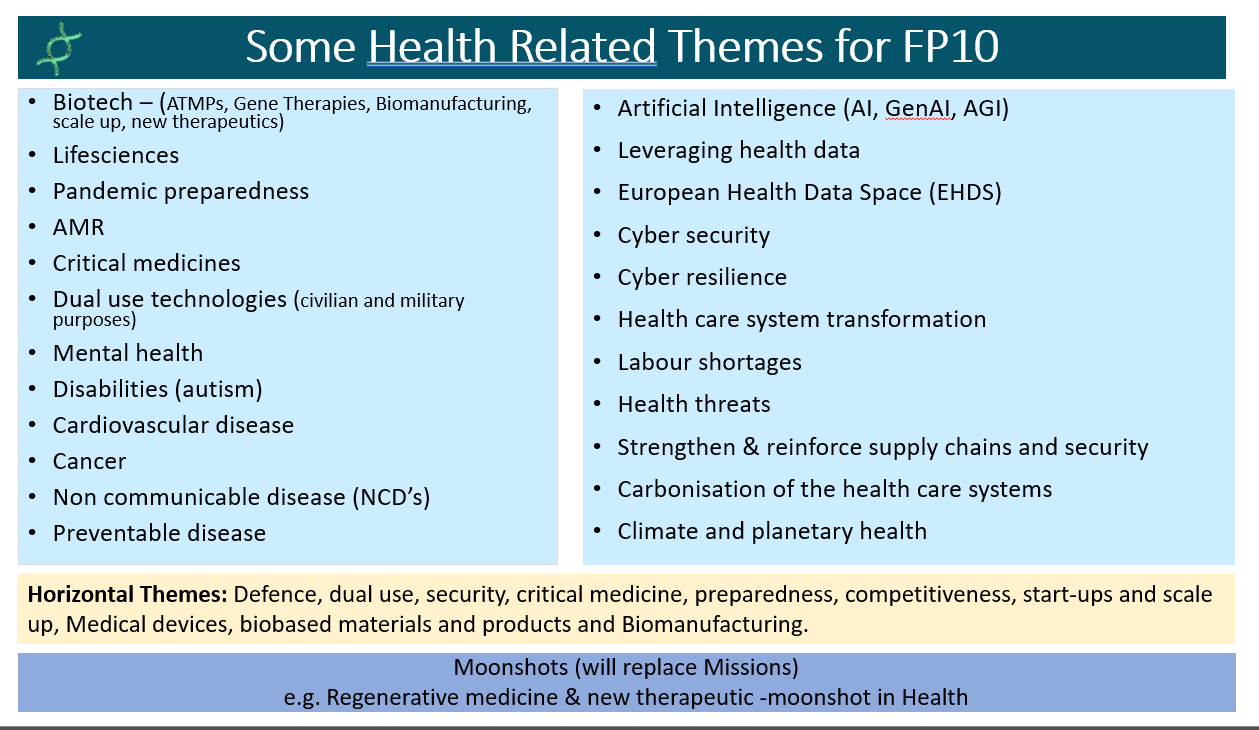
Future Health Related Themes for the next Framework Program
Top level reports and policies such as the Letta Report, Draghi Report, Heitor Report on Europe’s competitiveness, challenges and future growth have been completed.
Health specific policies and plans have also been developed such as Europe’s Lifesciences Strategy, The European Biotechnology Act, Critical Medicines Act (CMA), the EU Cardiovascular health- The Safe Hearts Plan, Strategic research and innovation agenda on health and climate change and One Health governance in the European Union. These and other relevant reports will influence the agenda and priorities in the next Horizon Europe Health program. New concepts such as dual use or dual benefit technologies will be funded. The concept of moonshots (which will replace the Missions) will focus on Regenerative & Precision Medicine: covering advanced therapies, gene and cell treatments, AI‑enabled personalised healthcare and initiative for our ageing society.
Here is a snap shot the health related themes and areas of research likely to be covered in FP10.