

Mark Sweeney
National Contact Point (NCP) for Horizon Europe Cluster 5 - Climate, Cluster 6 - Environment and NCP for Climate Adaptation Mission
Enterprise Ireland

With the vast majority of Cluster 6 Call topics closed for 2024, one significant area of opportunity that is open for applications until the 18 September is the Circular Biobased Europe Joint Undertaking (CBE JU).
The CBE JU is a €2 billion partnership between the European Union and the Bio-based Industries Consortium (BIC). Under the 2024 Call for Proposals, a total of €213 million is available to advance competitive circular bio-based industries in Europe across 18 topics.
What can CBE JU do for Europe?
Shifting from non-renewable fossil raw materials and minerals to circular bio-based production processes is essential to reach the EU’s climate targets as set out in the European Green Deal. Strong, resource-efficient and competitive bio-based industries are important drivers of this change. By producing renewable bio-based products and materials from waste and biomass in an innovative, sustainable and circular way, they can contribute significantly to the climate neutrality target by 2050 while creating green jobs and sustainable economic growth in regions across Europe.
The role of Circular Bio-based Europe is to bring together various actors from bio-based industries, ranging from farmers to scientists, to solve the technological, regulatory and market challenges of the sector. Its public-private funding scheme boosts innovation and market deployment and paves the way for future investments.

18 Call topics now open to support three CBE JU objectives:
In 2024, CBE JU will continue to support the scaling up of technologies leading to industrial deployment, thus boosting investment and job creation at regional and local level, in line with the CBE JU objectives:
• Accelerate the innovation process and development of bio-based innovative solutions
• Accelerate market deployment of existing mature and innovative bio-based solutions
• Ensure a high level of environmental performance of bio-based industrial systems
Innovation actions – flagship (IA-flagship)
• Bio-based value chains for valorisation of sustainable oil crops - €20 million
• Bio-based dedicated platform chemicals via cost-effective, sustainable and resource-efficient conversion of biomass - €20 million
• Bio-based value chains for valorisation of sustainable natural fibre feedstock - €20 million
Innovation actions (IA)
• Bio-based materials and products for biodegradable in-soil applications - €15 million
• Sustainable microalgae as feedstock for innovative, added-value applications - €15 million
• Enlarging the portfolio of commercially produced “Safe and Sustainable by design” (SSbD) solvents - €15 million
• Circular and SSbD bio-based construction & building materials with functional properties - €15 million
• Selective and sustainable (co)-production of lignin-derived aromatics - €15 million
• Innovative bio-based adhesives and binders for circular products meeting market requirements - €15 million
• Innovative conversion of biogenic gaseous carbon into bio-based chemicals, ingredients, materials - €15 million
Research and innovation actions (RIA)
• Valorisation of polluted/contaminated wood from industrial and post-consumer waste streams - €7 million
• Biotech routes to obtain bio-based chemicals/materials replacing animal-derived ones - €7 million
• Sustainable, bio-based alternatives for crop protection - €10 million
• SSbD bio-based coating materials for applications under demanding and/or extreme conditions - €7 million
• Innovative bio-based food/feed ingredients - €7 million
Coordination and support actions (CSA)
• New forms of cooperation in agriculture and the forest-based sector - €4 million
• Supporting the CBE JU Deployment Group on Primary Producers - €3 million
Where to find more information?
Take a look at the call page for more information and follow the links to the CBE JU Annual Work Programme 2024, as well as FAQ for applicants. Please keep an eye on updates of this FAQ, as its section 6 contains a Q&A related to topic interpretation.
CBE JU has launched a free networking platform to help stakeholders get in touch with each other, pitch their project ideas or offer their services and search for partners. Join over 1,400 CBE JU community members on the platform and schedule meetings with your future project partners.
You can also watch back the CBE JU info day about the call and download the presentations from the event website.
MTU to lead €9 million CBE JU Farm-based Grass Biorefinery Demonstration Initiative
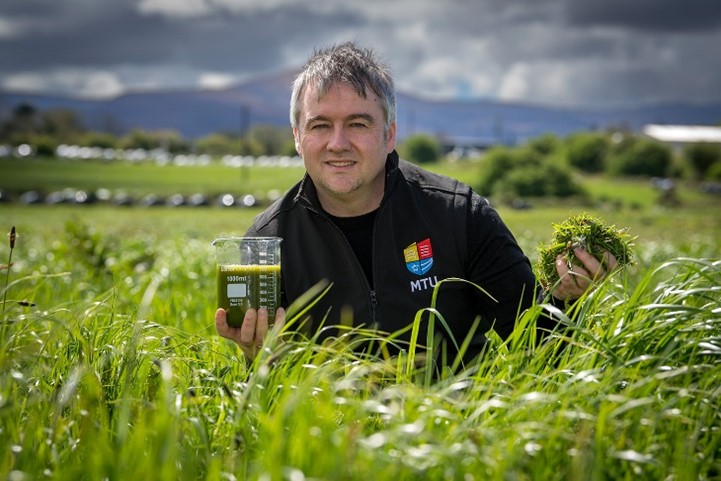
Ireland performed extremely well in the 2023 CBE JU Call with several Irish participants successful. A great example of this is the Rural BioReFarmeries project coordinated by James Gaffey (pictured), co-director of the Circular Bioeconomy Research Group (CircBio) at MTU. James will lead a first-of-its-kind decentralised green biorefinery demonstration initiative. The €8.7 million project will advance the development of farm-centred bioeconomy approaches through the deployment of green biorefineries across grassland regions of Europe.
Under the project two primary green biorefinery and anaerobic digestion (AD) demonstration sites in Ireland and Denmark will convert grasses, clover and green biomass residues sourced from local farms into value-added products. This will include human and animal grade protein, bio-based food packaging, flavours, anti-microbials, fertiliser and energy.
It will work intensively with primary producer partners on the ground, including within the dairy and pig sectors, while also linking these farms to research and industrial sites in Netherlands, Ireland, Denmark and Poland.
Speaking about the initiative, project coordinator James Gaffey said that emerging grass-based value chains represent a major strategic opportunity for the EU bioeconomy.
“By improving the efficiency and circularity of our vast European grasslands, we can produce, not only forage, but also food, high value materials and energy.
Green biorefineries are a key enabling technology which can help rural grassland farmers to address challenges such as income diversification, accessing sustainable inputs for their farms, displacing unsustainable products and contributing to our climate and sustainability targets.
Rural BioReFarmeries builds on the latest research of various EU countries to optimise green biorefineries by overcoming existing limitations and implementing these business models on the ground with farmers, cooperatives and other industries across multiple sectors.”
Rural BioReFarmeries brings together 19 partners from 8 countries including MTU, Aarhus University in Denmark, University College Dublin (UCD), Barryroe Cooperative, University of Galway and Trinity College Dublin.
Carbery Group is also part of the initiative through its flagship project Farm Zero C – which is creating a model for climate neutral dairy farming.
For any further enquires in relation to the CBE JU and related call topics contact: